Download PDF Agile Principles, Patterns, and Practices in C#
Going to an internet site that is extremely completed as in this area is unusual. So, it's your good luck to discover us. And pertaining to the Agile Principles, Patterns, And Practices In C#, we provide you this book in soft file. So, you will not need to really feel hard to bring the printed book when preparing to review it every single time. If you feel bemused concerning how you can get it, you could conserve the documents in your gizmo and also other tool. So, when you open the device, you can be advised regarding guide inside.
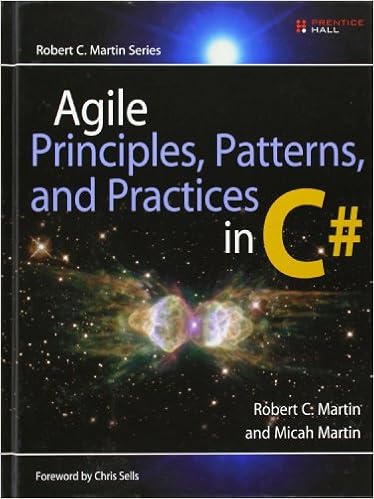
Agile Principles, Patterns, and Practices in C#

Download PDF Agile Principles, Patterns, and Practices in C#
Agile Principles, Patterns, And Practices In C#. Bargaining with checking out routine is no need. Reviewing Agile Principles, Patterns, And Practices In C# is not type of something marketed that you could take or otherwise. It is a point that will change your life to life much better. It is the many things that will certainly give you lots of things worldwide as well as this cosmos, in the real world as well as here after. As just what will certainly be provided by this Agile Principles, Patterns, And Practices In C#, exactly how can you bargain with the many things that has several advantages for you?
Reviewing will not just provide the brand-new expertise regarding what you have reviewed. Reading will additionally educate you to assume open minded, to do carefully, as well as to get rid of the boredom. Reviewing will be always excellent as well as significant if the product that we check out is additionally a good book. As example, Agile Principles, Patterns, And Practices In C# is a god book to read for you. This suggested publication turns into one of the books that will certainly get rid of a brand-new maker to invest the time carefully.
Now, you might understand well that this publication is mainly advised not only for the viewers that enjoy this topic. This is also promoted for all individuals as well as public type culture. It will certainly not limit you to check out or otherwise guide. But, when you have begun or started to read DDD, you will understand why precisely the book will certainly offer you al positive points.
To make certain, many individuals additionally have downloaded the soft documents of Agile Principles, Patterns, And Practices In C# though this website. Just by clicking web link that is given, you could go straight to guide. Once again, this book will be really important for you to review, even they are basic, and also they will lead you to be the much better life. So, exactly what do you think of this updated book collection? Let's inspect it now as well as prepare to make this publication as definitely your collection and also reading products. Believe it!
From the Back Cover
With the award-winning book "Agile Software Development: Principles, Patterns, and Practices, " Robert C. Martin helped bring Agile principles to tens of thousands of Java and C++ programmers. Now .NET programmers have a definitive guide to agile methods with this completely updated volume from Robert C. Martin and Micah Martin, "Agile Principles, Patterns, and Practices in C#."This book presents a series of case studies illustrating the fundamentals of Agile development and Agile design, and moves quickly from UML models to real C# code. The introductory chapters lay out the basics of the agile movement, while the later chapters show proven techniques in action. The book includes many source code examples that are also available for download from the authors' Web site.Readers will come away from this book understanding Agile principles, and the fourteen practices of Extreme Programming Spiking, splitting, velocity, and planning iterations and releases Test-driven development, test-first design, and acceptance testing Refactoring with unit testing Pair programming Agile design and design smells The five types of UML diagrams and how to use them effectively Object-oriented package design and design patterns How to put all of it together for a real-world projectWhether you are a C# programmer or a Visual Basic or Java programmer learning C#, a software development manager, or a business analyst, "Agile Principles, Patterns, and Practices in C#" is the first book you should read to understand agile software and how it applies to programming in the .NET Framework.
Read more
About the Author
Robert C. Martin has been a software professional since 1970 and an international software consultant since 1990. He is founder and president of Object Mentor, Inc., a team of experienced consultants who mentor their clients in the fields of C++, Java, OO, Patterns, UML, Agile Methodologies, and Extreme Programming. Micah Martin works with Object Mentor as a developer, consultant, and mentor on topics ranging from object-oriented principles and patterns to agile software development practices. Micah is the cocreator and lead developer of the open source FitNesse project. He is also a published author and speaks regularly at conferences.
Read more
See all Editorial Reviews
Product details
Hardcover: 768 pages
Publisher: Prentice Hall; 1 edition (July 30, 2006)
Language: English
ISBN-10: 0131857258
ISBN-13: 978-0131857254
Product Dimensions:
7.4 x 2 x 9.6 inches
Shipping Weight: 2.8 pounds (View shipping rates and policies)
Average Customer Review:
4.3 out of 5 stars
48 customer reviews
Amazon Best Sellers Rank:
#230,080 in Books (See Top 100 in Books)
There are a few reasons why I rated this book a 3. So let me list some pros/cons.PROS=====The book is worth a read because it contains some valuable information. Especially the chapters on the SOLID principles, the component packaging principles (analogous to the SOLID principles, but for components), and the chapter on component and class metrics that was very interesting. Those chapters are well written and I think demonstrate the principles well. Granted, you can probably find this information elsewhere. Probably why I rated the book a 3 instead of a 4.In addition, the refactoring chapter was pretty good, too. And there were several chapters that covered the basic, most common design patterns that most programmers should know if they already don't.CONS=====The book was written in 2007, and so is dated. For example, there is no use of generics anywhere in the sample code. IIRC, generics came out just after this book was published. Therefore, some of the examples given don't translate quite as well to the features now available in C#. Secondly, you can tell the examples are translated from Java. The original Clean Code book written by Robert C Martin is in Java--as that is a language the he programs in often. His son, who helped write this book, does program in C# (and probably Java)--but you can tell the examples still have Java programming idioms in them. (Full disclosure, I'm not a huge Java fan--that's my personal preference.) More importantly, however, is that Java has it's own coding conventions adopted by those who program in it, e.g. getSomething, setSomething (since Java doesn't have syntactic sugar for getters/setters), no 'I' in interfaces, it's just a List, not an IList--unlike C#. But the authors routinely ignore C# coding conventions in their examples, such as using camel case for methods and preferring getXXXX/setXXXX over .NET properties, and not prefixing interfaces with 'I'. For the record, I agree with the authors that prefixing interfaces with 'I' should not be necessary, nonetheless, it's a .NET coding convention.What I'd really like to see is the author update this book, including all the examples. Show us how you would write SOLID code using .NET generics; the role that lambdas play when writing SOLID code; and use .NET coding conventions throughout.Other than that, as I said at the beginning, the book still has a lot of good information in it that makes it worthwhile to pick up and read.
This is a terrific book. I'm a big proponent of the Robert Martin library of books, as I think he really knows his stuff. This is listed as just him and his son, but I do believe there are "guest contributors" as well.One of the things I like about this is that it not only discusses Agile in C#, but it also has real, honest to goodness code examples. It also has more real-world examples of SOLID and non-SOLID code, with explanations of how to fix the non-SOLID code.If I were to note one critical thing, I would like to see how SOLID ties in with Design Patterns.All in all, if you're a programmer at any level, I would seriously recommend adding this to your library. Not necessarily for the version of C# (since that changes), but for the concepts therein.
After finishing this book and thinking about how useful its contents would be for me in the workplace right now in the (almost) final quarter of 2014, I have concluded that this book is a valuable addition to my programmer bookshelf, albeit a mixed bag of good and stale bits. The good aspects of this book will remain useful. However, the stale parts are... well... a little too stale and beg for a new edition, which it seems Uncle Bob doesn't plan to undertake.The good points:The book has aspects that will keep this book on the shelf, ready to crack open at a moment's notice: justification for denouncement of excessive documentation and diagramming, encouragement of realistic / sustainable work hours, explanations of design patterns in a (loosely) C# context, explanations of agile PPPs from an angle I had not previously considered, demonstrations on how to produce reliable software development estimates, emphasis on test-first design / development as the foundation on which this book is written, the list could go on (but not much further).The stale points:To be fair, any language specific examples will become stale pretty quickly, as technology is always advancing at breakneck speeds. The Author(s) do state early on that they're not telling you "how to do C#!"; rather, they're extending a lofty olive branch to the .NET developer community (thanks....?) and wanting to discuss more language agnostic topics (refer to the good points listed above). A lot of reviewers point out that C# is really just a namesake in this book. Therefore, let's just go ahead and say it: the C# is really stale; there are such amazing things C# can do now that have made the language much more expressive, maintainable, dynamic, and capable. Funnily enough, some of these advancements were called for in Jack Reeves' article included in Appendix B of this book when he was referring to C++'s success at its onset.In a nutshell:This book is worth having around. I will refer back to this book often for inspiration on various design patterns. However, I would like a more modern C# publication on implementing these patterns in a way that actually leverages the language and avoids (now) known anti-patterns. It would be grand if someone took the content of this book to the next level with more modern insight.After having finished Agile C#, I experienced enlightenment in some ways, but at the same time, I need a C# palate cleanser.
While the material applies to any modern object oriented programming language , .NET as a framework and C# in particular, the concepts are very solid and can be applied to any programming language.I feel the take away from the chapters I read is , "Code today as if you're delivering tomorrow , design as if you're have a 5 year project" and you will get it done right.
Agile Principles, Patterns, and Practices in C# PDF
Agile Principles, Patterns, and Practices in C# EPub
Agile Principles, Patterns, and Practices in C# Doc
Agile Principles, Patterns, and Practices in C# iBooks
Agile Principles, Patterns, and Practices in C# rtf
Agile Principles, Patterns, and Practices in C# Mobipocket
Agile Principles, Patterns, and Practices in C# Kindle


0 komentar:
Posting Komentar