PDF Download Empires of the Word: A Language History of the World
You may not should be question regarding this Empires Of The Word: A Language History Of The World It is not difficult means to obtain this publication Empires Of The Word: A Language History Of The World You could merely visit the distinguished with the web link that we supply. Below, you could acquire guide Empires Of The Word: A Language History Of The World by on the internet. By downloading Empires Of The Word: A Language History Of The World, you can locate the soft file of this book. This is the local time for you to start reading. Even this is not printed publication Empires Of The Word: A Language History Of The World; it will precisely give even more benefits. Why? You could not bring the published publication Empires Of The Word: A Language History Of The World or stack guide in your house or the office.
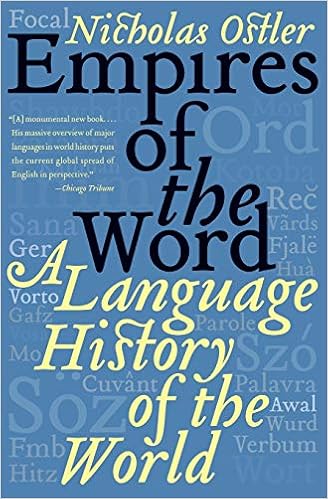
Empires of the Word: A Language History of the World

PDF Download Empires of the Word: A Language History of the World
When a new decision comes to be a brand-new manufacturer of better living, why should regret of it? Something old should be transformed and also renewed with something new, if the brand-new point is better. As the extra task that we will recommend, if you have no concept to appreciate your leisure time, analysis could assist you to kill time carefully. Yeah, killing time fully can be done by everyone. But, be sensibly in spending the moment is very unusual. So, do you want to be just one of the wise people?
The means to obtain this book Empires Of The Word: A Language History Of The World is extremely simple. You might not go for some places and spend the time to just discover guide Empires Of The Word: A Language History Of The World As a matter of fact, you may not constantly obtain the book as you're willing. But here, just by search and discover Empires Of The Word: A Language History Of The World, you can obtain the listings of guides that you really expect. In some cases, there are several books that are showed. Those books obviously will surprise you as this Empires Of The Word: A Language History Of The World compilation.
Now, delivering the books for you is kind of essential point. It will certainly obviously aid you to locate the book quickly. When you actually require the book with the same subject, why do not you take Empires Of The Word: A Language History Of The World currently as well as here? It will not be so hard. It will certainly be so easy to see how you intend to find the book to read. The discussion of individuals that like this book to review is a lot greater.
And also now, your opportunity is to get this publication as soon as possible. By seeing this page, you can in the link to go directly to the book. And, get it to become one part of this most recent publication. Making sure, this book is actually recommended for reading. Whether you are not followers of the writer or the subject with this publication, there is no fault to read it. Empires Of The Word: A Language History Of The World will certainly be actually excellent to review currently.
Review
“[A] wide-ranging history of the world’s languages... [Ostler] brilliantly raises questions and supplies answers or theories.” (Washington Post)“Enlightening . . . Always challenging, always instructive--at times, even startling or revolutionary.” (Kirkus Reviews)“Delicious! Ostler’s book shows how certain lucky languages joined humankind in its spread across the world.” (John McWhorter)“What an extraordinary odyssey the author of this superb work embarked upon.” (Literary Review)“Covers more rambunctious territory than any other single volume I’m aware of...A wonderful ear for the project’s poetry.” (John Leonard, Harper's Magazine)“Revolutionary... Executed with a giddying depth of scholarship, yet the detail is never too thick to swamp the general reader.” (Boston magazine)“True scholarship. A marvelous book, learned and instructive.” (National Review)“[A] monumental new book... Ostler furnishes many fresh insights, useful historical anecdotes and charming linguistic oddities.” (Chicago Tribune)“A work of immense erudition.” (Christian Science Monitor)“A story of dramatic reversals and puzzling paradoxes. A rich... text with many piercing observations and startling comparisons.” (Los Angeles Times Book Review)
Read more
About the Author
A scholar with a working knowledge of twenty-six languages, Nicholas Ostler has degrees from Oxford University in Greek, Latin, philosophy, and economics, and a Ph.D. in linguistics from MIT, where he studied under Noam Chomsky. He lives in Bath, England.
Read more
Product details
Paperback: 642 pages
Publisher: Harper Perennial; Reprint edition (June 27, 2006)
Language: English
ISBN-10: 9780060935726
ISBN-13: 978-0060935726
ASIN: 0060935723
Product Dimensions:
5.3 x 1 x 8 inches
Shipping Weight: 1.1 pounds (View shipping rates and policies)
Average Customer Review:
3.9 out of 5 stars
127 customer reviews
Amazon Best Sellers Rank:
#115,717 in Books (See Top 100 in Books)
The book is excellent.The ebook formatting, on the other hand, leaves a lot to be desired.1) Images (and there are hundreds of them, including many special characters) only appear in the "View on your Browser" environment or (presumably) on a direct-networked Kindle device. They do NOT appear on the Kindle for PC reader or, therefore (I believe) in side-loaded Kindles. (And if you convert and read the file on an ePub device, they don't appear there, either.) You can read the book without the images, but you are missing a lot of the helpful illustrations, and most of the unusually accented characters.2) Page references all point to the print edition and (of course) have no relationship to whatever digital device you use, nor are they live links.3) eBook pagination jumps all over the map. For example, on my device, crossing a chapter boundary moved me from p. 662 (of 696) to p. 140.
Despite the author's supple writing style, this can be a difficult book to read. Due to the incredible level of detail some readers will either feel intimidated or give up before the end. That would be regrettable, because there is much to learn from "EOTW." Ostler strikes a nice balance between discussing origins and early diffusion of languages and more recent centuries, which are both better-documented and presumably hold more interest for general readers. He neatly summarizes a number of ongoing debates about how languages change and spread, and where necessary, shows intimate familiarity with the more technical aspects of linguistics and language history. Another review criticizes, I believe too harshly, some errors concerning African languages, but Ostler gets the basics right. A work like this requires an author to frequently step beyond his/her formal expertise, so occasional gaffes are unavoidable. Some familiarity with both history and linguistics will help, but Ostler includes more than enough general history to provide context; in fact, readers will learn a great deal about the past beyond linguistics from "EOTW." Considering how important languages are as repositories of history, culture and local knowledge, this book provides a valuable service in making connections across time and space. It's worth the effort.
I would give this book 4 stars, it was a good read. But I had something of an issue with the production of the KINDLE version of the book. I'll get to that at the end of the review.In his introduction Nicholas Ostler says that his book is not a history of languages nor a comparative analysis of similarities and differences. But there is some of both in here. The focus, about which he says this is the first book, is a sociological examination of the regional (and eventually global) rise and fall of languages. His aim is understanding what factors, geographic, political, military, economic, and psychological, contribute (positively and negatively) to the history (rise, spread, maintenance, decline) of specific languages from antiquity to the present. Ostler goes back as far as the earliest writing. He covers the world from all of Far Eastern Asia (north and south), around to South Asia, the Middle East, Africa, Europe, and the Americas. With each group, he goes as far back as known writing allows and brings the languages forward to the present, mapping geopolitical events (world history) to their effect on the peoples of the regions (natives and interlopers) down to the present day.This huge scope takes a lot of time. But the book is not as long as it appears as the text proper ends at the 76% point, the rest of it taken up by the end-notes which are copiously sprinkled (as links) through the text. This is nothing if not a scholarly work. One technical quibble, there are both "end notes" proper, and "end chapter notes" using different symbol sets (numbers for the end notes, '*', and other symbols for the chapter notes). But there are not enough symbols to cover the number of chapter notes and they must be repeated within a chapter. Moreover, while in most chapters, the chapter notes are properly linked in the text, in a few they are not.In the end, Ostler is not able to cull the variety of language-impinging factors down to a few rules that predict what will happen to a given language. Given the geographic (world) and historical (7,000 years) scope of the work this is not surprising. No single language arc seems to have duplicated any other. No matter the various "similar factors", in each case there are also plenty of differences, and between the two lies an endless variation resulting in far more exceptions than examples of similar forces having similar effects. Nevertheless, the book does give one a sense of how the influences play out historically, the most important being the size of the language speaking population, the security of their regional political control, their geographic placement in the world, their placement in the history of technology. This was a long read to get to tentative and very generalized conclusions, but I think in this case there isn't much more that can be said. The book does a service by carefully evaluating the significance of the various factors impacting language evolution and geographic dispersion. I don't think Ostler has discovered anything new here, but he does well illustrate the impact of interaction between operative factors in broad historical periods.I admire Ostler for taking on a really hard problem and making some sense of it, but the book's production (at least the Kindle version) was not up to the task. This is a subject that demands maps and figures. Strangely, the book refers to maps and figures only two or three times in the [long] body of the text. Worse, there weren't any maps or figures anywhere to be found in this Kindle version. Even the few he references, were just not there. Of course I cannot speak for their presence or absence in the hard copy versions, but I do not think there is any excuse for leaving them out of the electronic version. What is going on here? I do not know, but the lack of visual aids here takes a lot away from the value of the book.
I'm not a linguist. This book made me think thoughts I'd never had before. At my age that's gold.
Empires of the Word: A Language History of the World PDF
Empires of the Word: A Language History of the World EPub
Empires of the Word: A Language History of the World Doc
Empires of the Word: A Language History of the World iBooks
Empires of the Word: A Language History of the World rtf
Empires of the Word: A Language History of the World Mobipocket
Empires of the Word: A Language History of the World Kindle


0 komentar:
Posting Komentar