Free PDF An Infamous Past: E.M. Cioran and the Rise of Fascism in Romania, by Marta Petreu
How many times we should say that publication and analysis is very important for individuals living? Guide presence is not only for the bought or perhaps offered stacked of documents. This is a really valuable thing that could transform individuals living to be much better. Even you are constantly asked to read a publication and review once more, you will really feel so hard when informed to do it. Yeah, lots of people likewise really feel that. Feel that it will certainly be so dull to check out books, from primary to adults.
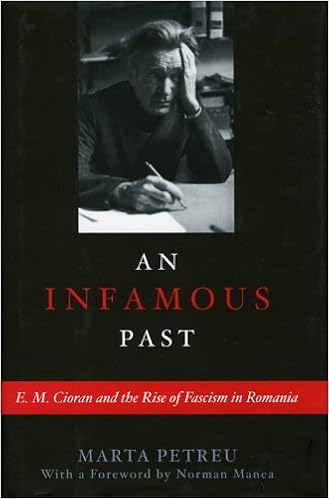
An Infamous Past: E.M. Cioran and the Rise of Fascism in Romania, by Marta Petreu

Free PDF An Infamous Past: E.M. Cioran and the Rise of Fascism in Romania, by Marta Petreu
There are many suggestions that people supply to boost the life high quality, concerning whatever. Below, we also will provide you a very easy suggestion to life much better. Reading An Infamous Past: E.M. Cioran And The Rise Of Fascism In Romania, By Marta Petreu is our pointer. Please ask why we suggest this book to check out. Lots of people attempt to make themselves to be abundant, yet sometime they ignore a very basic thing. Checking out is in fact a straightforward thing, however lots of are lazy to do it. It's kind of boring task and also waste the moment.
This is among your favourite books, right? That holds true. If this is just one of them, you can start by checking out page by web page for this book. The reasons might not be so challenging. We offer you an excellent book that will certainly not only motivate you but additionally show you the true life. When getting this publication to check out, it will be so various when you check out others. This is a new coming publication that makes this world so shacked. For your life, you could get many options and also advantages develop this An Infamous Past: E.M. Cioran And The Rise Of Fascism In Romania, By Marta Petreu
This publication will certainly reveal you the current publication that can be obtained in some locations. However, the inspiring book will be far more established. Yet this An Infamous Past: E.M. Cioran And The Rise Of Fascism In Romania, By Marta Petreu, it will certainly reveal you current point that you would like to know. Reviewing book as one of the activities in your vacations is really smart. Not everybody will have happy to do it. So, when you are person who like this publication to check out, you ought to enjoy the time reading and also completing this book.
When you need also the various other book style or title, find guide in this web site. One to remember, we don't only offer An Infamous Past: E.M. Cioran And The Rise Of Fascism In Romania, By Marta Petreu for you, we also have many lots of the books from lots of libraries the entire globe. Envision, exactly how can you get guide from other nation conveniently? Simply be here. Just from this web site you can discover this problem. So, just accompany us now.
From Publishers Weekly
Romanian poet, philosopher and editor Petreu shows in this dense but fresh work that many Romanian intellectuals were seduced by fascist ideology during the interwar years—and that philosopher Cioran, an "aphorist of humorous despair," was haunted by this legacy for the rest of his life. Petreu details the ultranationalist, pro-Christian ideology of the Legion of the Archangel Michael, a movement of intellectuals that gained prominence in Romania after WWI. As with many ideologies of the era, Petreu writes, anti-Semitism lay at the movement's core. Cioran's own ideology, rooted in the wish to turn Romania's "depressing present into a grandiose future," included a more complex view of Jews, outlined in his 1936 The Transfiguration of Romania. He envied what he saw as Jewish productivity in government, business and the arts. But Petreu shows how his outlook, adapted from Spengler, also necessitated hostility toward Jews and other non-Romanians. Cioran left Romania after WWII and became ashamed of his earlier fascism, but Petreu mines his life for lessons to be learned today about how good intentions can lead to extremism. (Nov. 4) Copyright © Reed Business Information, a division of Reed Elsevier Inc. All rights reserved.
Read more
Review
An enormous contribution to our understanding not only of Romania's tormented past, but also of European intellectual history. (Marci Shore, Indiana University Slavic and East European Journal)Represents the most thorough analysis of Cioran's inter-war fascination with fascism and nationalism…thought-provoking read. (Patterns Of Prejudice)A thorough and vivid portrait of a Romanian gifted fascist thinker, who dreamed about ‘a Romania with the population of China and the destiny of France.' Like his legionary colleagues, Emil Cioran admired Hitler, justified his crimes and believed that capitalism was ‘immoral, Judaic and anti-Christian.' Unlike other Iron Guard ideologists, Cioran praised Lenin and envisioned a modern Romania driven by industrialization and urban values. Like his comrades, Cioran advocated a fascist dictatorship and cultivated Corneliu Zelea Codreanu, the criminal führer of the Iron Guard. But unlike his friend and fellow Iron Guard ideologist, Mircea Eliade, who did not show any willingness to part with his totalitarian past, Cioran had the decency, in his productive French exile, to regret his fascist youth and break with it. (Radu Ioanid)Dense but fresh work. (Publishers Weekly)A vivid social and political memoir. (Diane C. Donovan, editor, Midwest Book Review Midwest Book Review)A sure and unobtrusive guide to the fevered, alienated milieu that turned Cioran...into a passionate partisan of Hitler. (Robert Legvold Foreign Affairs)Excellent.... Marta Petreu's biography is a well-documented account of everything shameful that Cioran ever wrote. (Zbigniew Janowski First Things)Brilliantly thorough. (Carlin Romano The Chronicle of Higher Education)From now on, I'll never read Cioran with as much appreciation. (Eric Rasmussen University Of Illinois, Chicago)
Read more
See all Editorial Reviews
Product details
Hardcover: 348 pages
Publisher: Ivan R. Dee (September 15, 2005)
Language: English
ISBN-10: 1566636078
ISBN-13: 978-1566636070
Product Dimensions:
5.8 x 1.2 x 9 inches
Shipping Weight: 1.3 pounds (View shipping rates and policies)
Average Customer Review:
4.0 out of 5 stars
4 customer reviews
Amazon Best Sellers Rank:
#756,857 in Books (See Top 100 in Books)
The Chicago publisher Ivan R. Dee has already published one major Romanian book in English translation, Mihail Sebastian's JOURNAL 1933-1945. Petreu's book is something different--a clear, serious, and straightforward scholarly study, a type of book seldom undertaken by an American commercial publisher. It is well chosen, though its future depends entirely on the reputation of Cioran, and it will do little to enhance that reputation. Petreu is intimately familar with Cioran's writings, and quotes from them liberally. That alone would make this book an important source for readers of Cioran who cannot read Romanian. She has also troubled to read his 1930s journalism and his correspondence (some of which she has collected and published in Cluj), texts unavailable in English. There is some repetitiveness, but with good reason. Petreu also is a student of history and is able to place Cioran's "lyrical philosophy" and praise of fascism (and of Hitler) in the context of Romanian politics. This by no means excuses Cioran. Rather, Petreu shows how and why fascism appealed to him in his twenties, when his literary ambitions, his dismay at European contempt for Romania, and his faith in destiny converged in opportunistic rant. Later in life, Cioran bitterly regretted these years. Petreu provides the ugly details, showing how much he had to regret. Finally, her discussion of the Iron Guard, the blackshirts of Romania, who murdered and marauded in the name of pure Christianity, is a frightening reminder of what militant Christian politics can do. Petreu writes that Cioran's "fundamental nature--decadent, amoral, aesthetic" (p. 182) was a fertile ground for his commitment to Romanian fascism. Cioran's current fame as a writer and a philosopher rests on the books he published in Paris after World War II. Petreu's book provides vital background for his Parisian career, showing how his fascist years continued to affect his later work, sometimes with hints, often with suppression, and always with fear and revulsion.
The book is excellently researched (kudos to the author, Marta Petreu). However, even the best biographer must find it difficult to summarize someone like Emil Cioran, who had trouble organizing his own words into a coherent text. Reading about the articles and books he wrote is like listening to a broken record: I'm ashamed to be a Romanian. Romania will never become a culture (nation). They can't blame anyone but themselves for being a total historic failure. On and on.The author did a great job of trying to present his one-track exposition (though he changed trains of thought in his later life). Actually, the best summary of Cioran's youthful, radical philosophy was given near the end of the book, when Marta organized his words into his "confession."In spite of its drawbacks (Cioran was, after all, only a "bit player" in the generation of 1927 compared to Mircea Eliade or even professor Nae Ionescu), it's a book that's worth reading. I especially enjoyed Chapter 10 ("Cioran and the Ideologies of His Time"), which compared the thoughts of others in his generation to those of Cioran.Before I read the book, I had no positive or negative thoughts about Cioran. After I read the book, I grew to dislike the guy who sponged off of others, refusing to work, pretending to be an intellectual. But I guess these were the kind of people who made a difference in inter-war Romania. And worth reading for that reason.
I first came across Cioran by reading "On the Heights of Despair" in college. I loved it. I felt like for the first time I was encountering someone who also had a bad penchant for cosmic pessimism. It was cathartic to read angst-ridden rants while being depressed over Heidegger's Being and Time. So, I read several of Cioran's other books. Not as biting, but I was still interested and wanted to learn more. At the time, I started researching the "conservative revolutionaries" of the 1930s -- thinkers like Heidegger, Carl Schmitt, Arthur Moeller van den Bruck, Stefan George, Ernst Jünger, et al., and I started to notice some affinities between the themes in Cioran and these thinkers. Eventually the darkness got a bit annoying and started to seem really hackneyed. It eventually clicked: yeah, Cioran basically makes all the same points as the fascists. He goes on and on about how mythos and emotion and irrational drives trump reason or logos, how the nation must come first and have an imperialist drive to crush other nations, how sacrifice for a higher cause is awesome, and all the other clichés. I started to get really annoyed by the way he refuses to actually dig into a subject and reflect on it, but usually only offers fleeting metaphors and parables. Some say this is great style, but it hardly helps get to the core of any subject.So, eventually I came across Marta Petreu's book and decided to check it out.On the one hand, this book certainly points out Cioran's right-wing affinities. However, the author constantly fails to really get what the essence of nationalism, fascism, or anti-Semitism is about. Instead, one gets these tepid attempts to claim that Cioran was "subtle" and "not really an anti-Semite." The killer evidence is that, to paraphrase, "Cioran, even though he says negative things about jews, also says positive things." Positive racism is still racism. On his death bed, Cioran says, "I...am...not...anti-Semitic!" The same kind of thing goes on with Nationalism: the author acts as if disappointed nationalists who only say negative things about their nation are somehow still not nationalists. On the other hand, the author points to where Cioran had affinities with "left-wingers." So, Cioran liked Lenin and the fact that the soviets pursued "social equality." He goes on about how he supports the permanent-revolution, but it has to be national. The book just goes around in circles comparing Cioran's positions to others in an endless commentary, attempting to show how Cioran didn't exactly fit in with the fascists, but was oh-so original.I suspect behind all the confusion lies these obnoxious thesis about left and right extremism going in a circle, both meeting, and how both are totalitarian. Of course, being totalitarian, they "aren't democracy." With this brilliant observation, one learns nothing about fascism, communism, or democracy. I absolutely hate when she talks about Marxism. It's just totally ignorant, but then so is Cioran's conceptions of Marxism which are all filtered through far-right sources. That's all irritating. The book really should have been edited down to about 150 pages. As someone else noted, Cioran really is a broken record.
An Infamous Past: E.M. Cioran and the Rise of Fascism in Romania, by Marta Petreu PDF
An Infamous Past: E.M. Cioran and the Rise of Fascism in Romania, by Marta Petreu EPub
An Infamous Past: E.M. Cioran and the Rise of Fascism in Romania, by Marta Petreu Doc
An Infamous Past: E.M. Cioran and the Rise of Fascism in Romania, by Marta Petreu iBooks
An Infamous Past: E.M. Cioran and the Rise of Fascism in Romania, by Marta Petreu rtf
An Infamous Past: E.M. Cioran and the Rise of Fascism in Romania, by Marta Petreu Mobipocket
An Infamous Past: E.M. Cioran and the Rise of Fascism in Romania, by Marta Petreu Kindle


0 komentar:
Posting Komentar